Contextual AI model in marketing: how it works and why it beats a prompt
You type "write an ad for my salon" into ChatGPT and get text that could be an ad for any salon in the world. Not yours. Not for your customers. Not in your city. AI wrote something generic because it didn't know anything specific. And generic marketing doesn't convert.

Why a regular prompt gives poor marketing results
A prompt is a question to a model that knows nothing about you. But it knows a lot about all companies similar to yours. That's why its answer is a statistical average for the industry — safe, correct, unremarkable.
Kahneman proved that System 1 (emotional, fast) makes 95% of purchasing decisions. Generic text doesn't hit System 1 because it doesn't address specific pains of specific people. It hits System 2 — and ends up in the trash.
"Your dream salon is waiting for you. We invite you to take advantage of our exceptional services."
"Damage-free coloring — see why 340 clients came back to us a second time."
What is a contextual AI model?
A contextual AI model is ChatGPT or Claude that receives a knowledge package about your company before each query. This package contains at least:
- Customer persona with specific pains, language and objections (not generic "women 25–45")
- Company USP in benefit language (not "professional service", but "response within 2 hours")
- Main objections customers raise before purchase
- Communication tone and forbidden words
- Case studies and numbers to cite
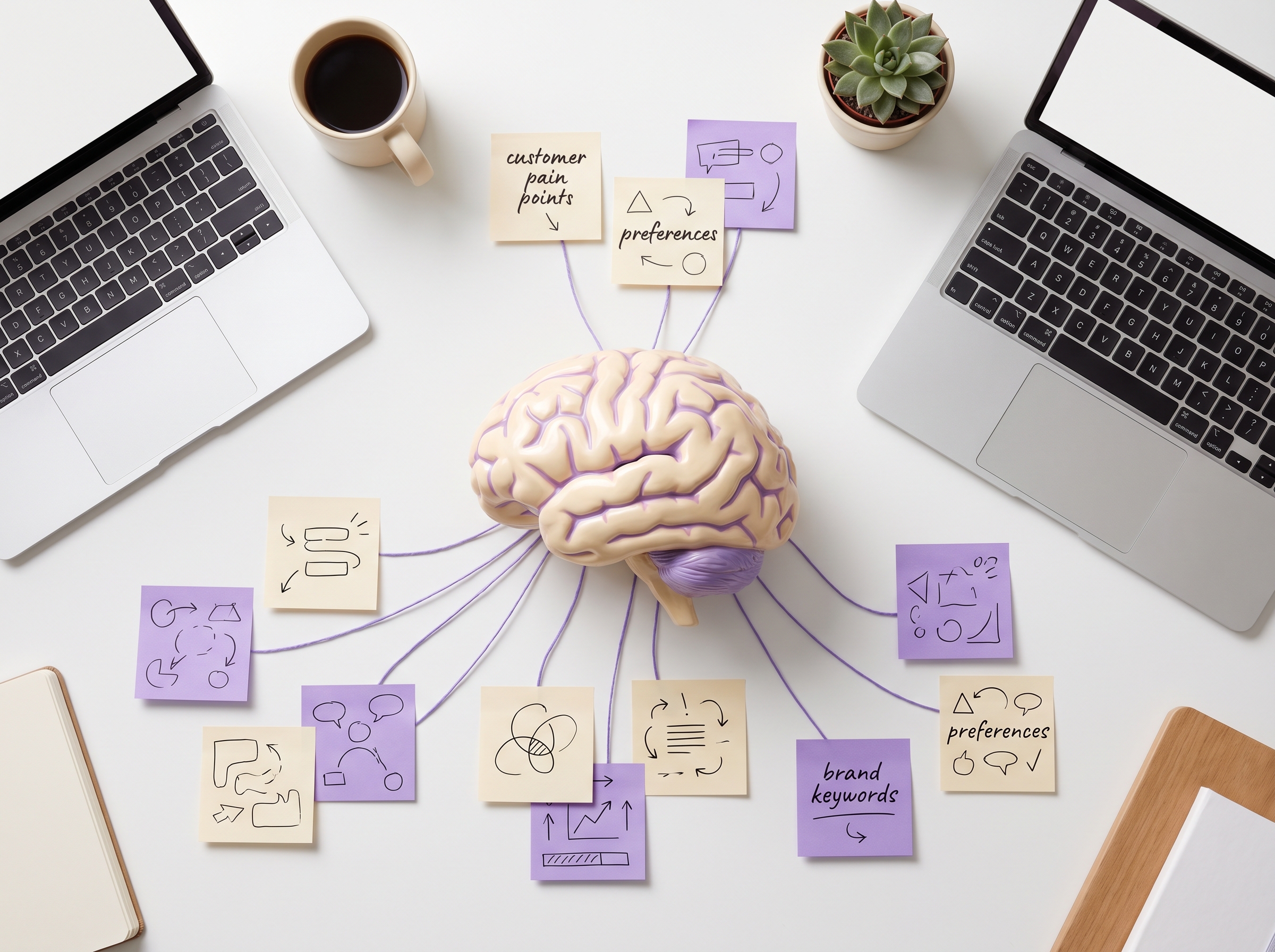
How we build contextual AI models for Ad Plus clients
Stage 1 — Contextual interview (days 1–2)
90-minute session with the owner or manager. We analyze 20–50 recent conversions and 10–20 lost customers. We extract language patterns, not demographic categories.
Stage 2 — Building brand context (days 3–5)
We create a brand context document: 3 behavioral personas, pain and gain map, customer language dictionary, objection matrix with reframing.
Stage 3 — Model calibration and testing (days 6–9)
We embed context into AI system prompts. We generate 30 content variants and test CTR on a small budget (500–1000 PLN). The winning variant goes into the full campaign.

Results: context vs. no context
Based on 18 campaigns run by Ad Plus in 2024:
- Ad CTR with context: average 4.1% vs 1.3% without context
- CPL (cost per lead): 58% lower with context
- Time to create 10 ad variants: 45 minutes with model vs 3 days without
- Percentage of ads requiring revisions: 12% with model vs 67% without
Most common questions about contextual AI models
Does my data go into OpenAI training?
No, if you use the API or Enterprise version. Ad Plus works exclusively on the API, where client data is not used for model training. Every implementation includes a DPA agreement.
What if I don't have data — the company is new?
Data can be replaced with an interview with the owner and competitive analysis. Context built from 5 conversations with potential customers is better than no context.
Isn't this the same as a good copywriter?
A good copywriter with context and AI with context produce similar quality. The difference: AI generates 50 variants per hour, a copywriter — 3 per week. We use both — human supervises, AI scales.
How long does it take to create the model?
9 business days from kickoff to first campaigns. Context update once per quarter or after offer changes.
How much does implementing a contextual AI model cost?
Pricing is determined individually and depends on industry complexity, number of personas and campaign scope. Model building is part of the collaboration setup — you don't pay for it separately. Book a free consultation and we'll provide an exact quote for your case.