Contextual AI model in marketing: how it works and why it beats a prompt
You type a prompt into ChatGPT and get an answer that sounds convincing - but has nothing to do with your company, your customers, or your industry. That's the fundamental problem with generic prompts. A contextual AI model works differently: it knows your business the way a good employee does after a year on the job.
TL;DR
A contextual AI model learns from your company's data: its offer, campaign history, customer conversations, and sales patterns. It generates content tailored to your business instead of generic copy that fits everyone. Ad Plus builds such a model in 9 business days, including the interview, testing, and team training. Most clients see a difference in content quality within the first week, and measurable campaign results after 3-6 weeks. Company data is stored in an isolated, GDPR-compliant environment and is never used to train public AI models.

Why a generic ChatGPT prompt isn't enough
ChatGPT is an extraordinarily powerful tool - but in its general form, it knows nothing about your company. It doesn't know your best-selling services, it doesn't understand why customers keep coming back, it can't anticipate the objections that come up during sales conversations. Every prompt is essentially a conversation with someone meeting you for the first time.
The result is predictable: generic copy that fits any company and none in particular. Marketers spend hours revising, refining, and rewriting. And the results are still mediocre, because AI without context can only go so far.
What "context" actually means for an AI model
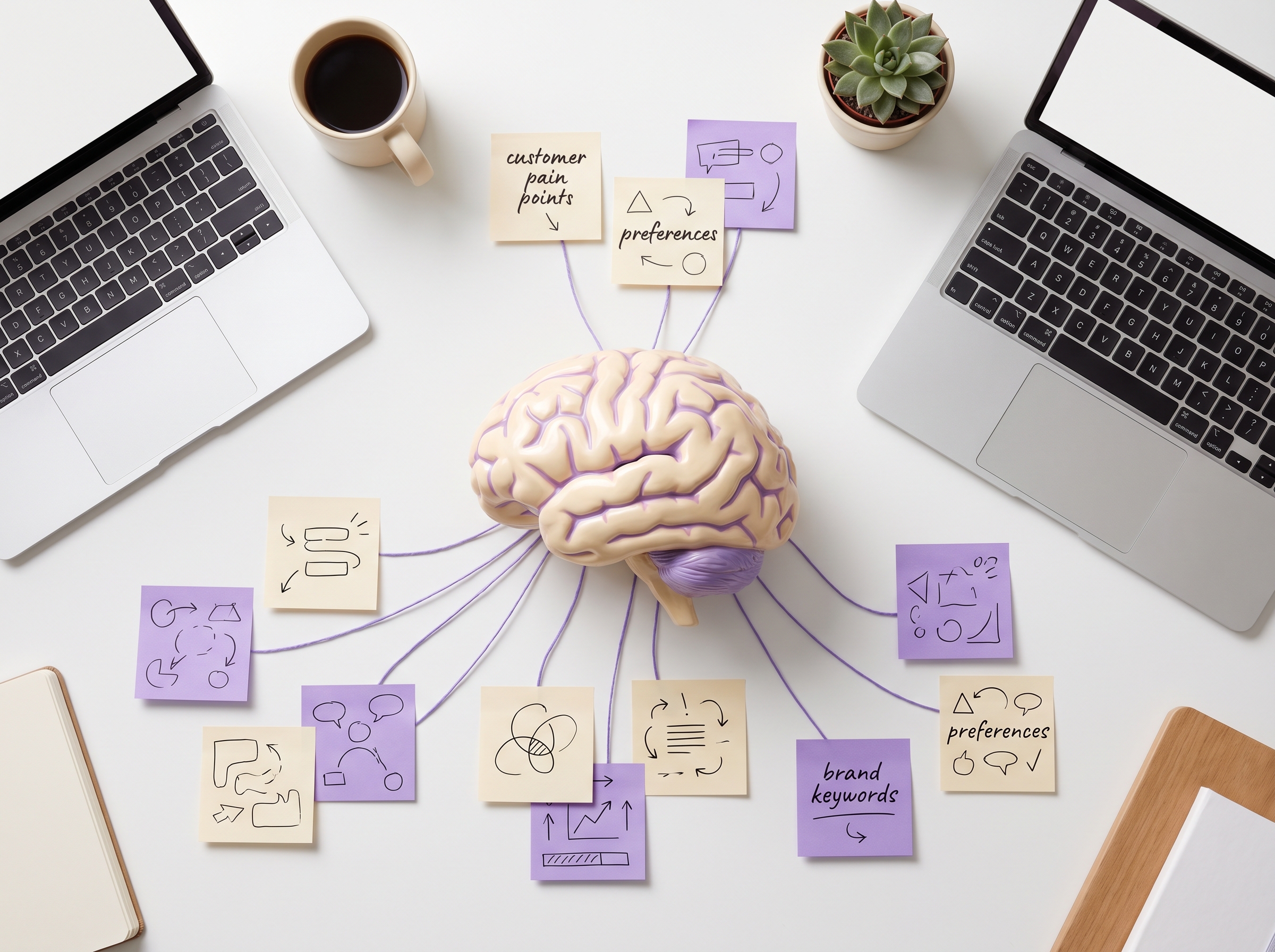
Context is the set of data the model receives before it starts generating responses. The richer and more precise the context, the more accurate the output. In practice, context for a marketing model consists of several layers:
- Company data: offer, USP, positioning, communication tone, brand values
- Customer data: segments, personas, common objections, the language customers actually use
- Campaign history: what worked, what didn't, which messages converted best
- Sales data: which products/services generate the highest margin, what the typical funnel looks like
- Post-sale feedback: reviews, complaints, questions that come up repeatedly
How Ad Plus builds a contextual AI model for your company
Building a contextual model starts with a deep-dive interview - not a survey, but a structured conversation that surfaces knowledge that often doesn't exist in any document. How many times have you heard a business owner say "Our customers choose us because…" - and that insight never made it onto the website or into any marketing material?
The data is then organized, tagged, and loaded into the model. This is supplemented by campaign data (if available), sales call transcripts, and competitor analysis. The model is then tested and calibrated - checking that it generates content consistent with the brand voice and that its recommendations make business sense.
The entire process takes 9 business days. After deployment, the company has a model that knows its business better than many employees do after three months on the job.

Results comparison: prompt vs. contextual model
The difference shows up most clearly in specific use cases. Here are examples from Ad Plus client work:
- Meta Ads copy: a generic prompt produces text that could belong to dozens of companies. The contextual model uses this company's specific sales arguments, its customers' own language, and references proven purchase motivators.
- Lead nurturing emails: general AI writes formally and generically. The contextual model knows what stage of the funnel the lead is at and adapts the message accordingly.
- Social media posts: instead of templated content - posts that sound like they were written by the business owner who genuinely knows their customers.
- Sales objection responses: the model knows the most common customer "but…" statements and has tested, ready-to-use responses for each.
Who is a contextual AI model for?
A contextual model works best for companies running active marketing - generating leads, running ad campaigns, building customer relationships through email or SMS. The fastest return on investment comes for companies that previously relied on an external copywriter or did marketing "after hours."
The typical Ad Plus client is a service business owner or SME in B2B or B2C who wants to scale marketing without proportionally increasing costs. An AI model doesn't replace strategy - it's a tool that makes executing that strategy faster and more consistent.
Summary
A contextual AI model turns a generic tool into an assistant that understands your business and speaks your customers' language.
- The model learns from company data: offer, USP, customer segments, campaign history, sales data, and post-sale feedback.
- Ad Plus builds it in 9 business days: interview, organizing and tagging data, model build, testing and calibration, and team training.
- It works for Meta Ads copy, lead nurturing emails, social media posts, and sales objection responses.
- Most clients notice a difference in content quality within the first week after deployment.
- Measurable campaign results (higher CTR, lower CPL) typically appear after 3-6 weeks.
- Data is stored in an isolated, GDPR-compliant environment and is never used to train public AI models.
If you run active marketing and want every piece of content to sound like it was written by someone who knows your customers, now is a good time to talk. See how a contextual AI model can make your communication faster and more consistent.
FAQ
Does a contextual model need ongoing updates?
Yes - the model should be updated quarterly or after significant changes to the company's offer, campaign results, or customer profile. Ad Plus offers model updates as part of subscription packages. A company that regularly supplies new data gets a model that becomes increasingly accurate over time.
Is my company's data safe?
Yes. Company data is not used to train public AI models. The context is stored in an isolated environment accessible only to your organization. Ad Plus applies security standards compliant with GDPR and does not share client data with third parties.
How quickly do you notice a difference in content quality?
Most clients notice a clear difference with the first generated content - typically within the first week after deployment. Measurable campaign results (higher CTR, lower CPL) generally appear 3–6 weeks after launching the optimized materials.
Can I use the model independently after deployment?
Yes - the model is accessible through an intuitive interface that requires no technical knowledge. You can generate content, ask strategic questions, and use the model's recommendations without agency involvement. Ad Plus also includes team training as part of the deployment process.
How much does deploying a contextual AI model cost?
Cost depends on the complexity of your business and the scope of data to process. Contact Ad Plus for a personalized quote. Deployment takes 9 business days and includes the interview, model build, testing, and team training.